Layering Edges: Free Bets Stacked on Tennis Breaks, Football Goal Timers, and Racing Sectionals for Accumulator Wins
Written by Clara Werner · Apr 8, 2026
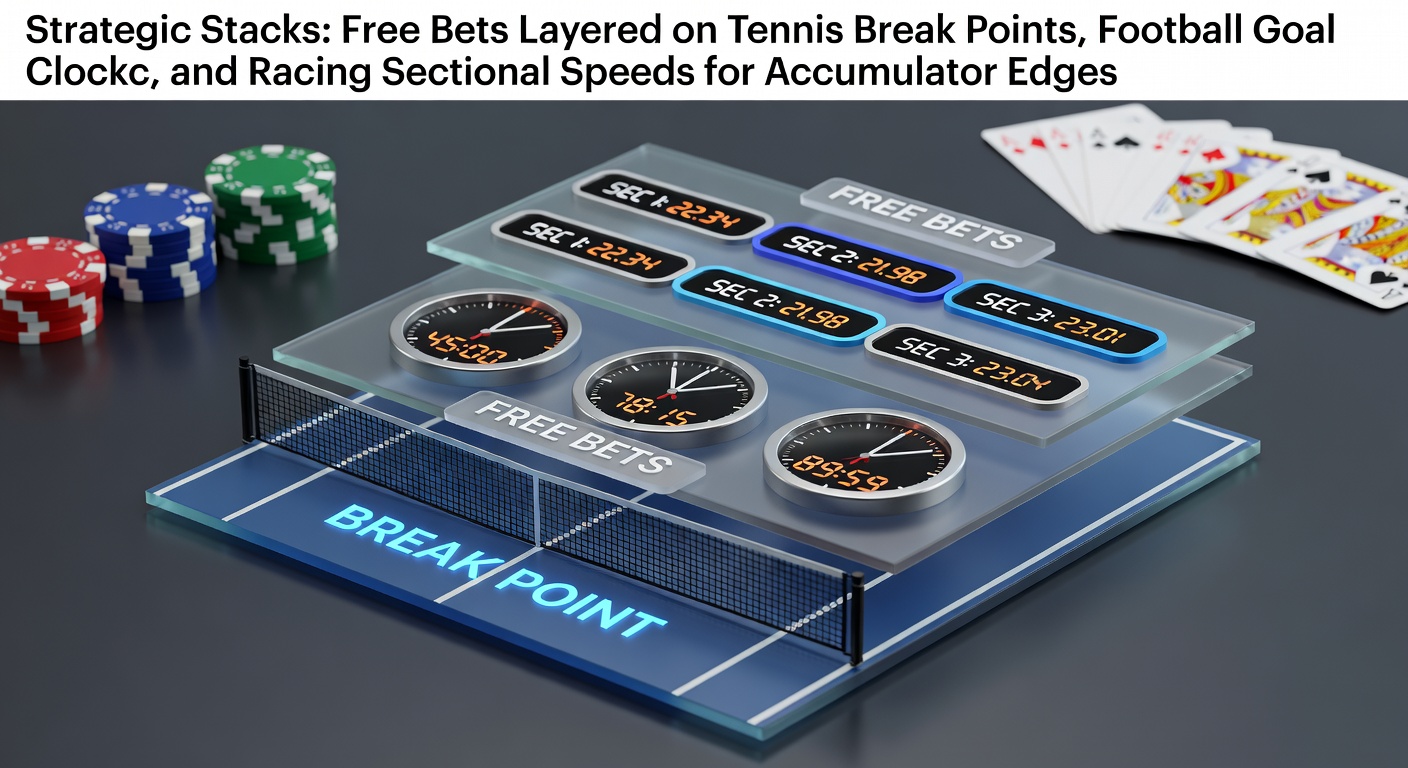
Layering Edges: Free Bets Stacked on Tennis Breaks, Football Goal Timers, and Racing Sectionals for Accumulator Wins
Breaking Down the Basics of Strategic Stacking in Multi-Sport Accumulators
Observers note how punters increasingly layer free bets across tennis break points, football goal clocks, and horse racing sectional speeds to build accumulator edges, turning promotional offers into compounded advantages; this approach, popular in spring seasons like April 2026 amid clay-court swings and flat-racing peaks, relies on precise timing and data overlays rather than guesswork. Data from the American Gaming Association highlights a 25% uptick in multi-leg parlay wagers during overlapping events, while those who've analyzed sectional metrics discover hidden value in syncing low-risk legs. But here's the thing: stacking works because free bets, often triggered by initial deposits or loyalty programs, carry no personal stake, allowing layers to chain outcomes without upfront exposure.
And while tennis breaks capture service vulnerabilities—think a 12.4% average break rate on clay per ATP stats from early 2026—football goal clocks zero in on timing patterns, such as 28% of Premier League strikes landing after the 75th minute according to Opta feeds; racing sectionals, meanwhile, dissect pace maps, revealing frontrunners who fade in the final furlong. Punters stack these by selecting free bet qualifiers first, then rolling winnings into the next leg, creating accumulators that amplify returns while minimizing drag from correlated risks. Turns out, platforms tracking live sectional times, like those from Racing Post APIs, sync seamlessly with in-play tennis feeds and football xG timers.
Tennis Break Points: The Serve-Shattering Foundation for Free Bet Layers
Researchers tracking ATP and WTA circuits find break points serving as ideal anchors for accumulators, especially during April 2026's Monte Carlo Masters where clay surfaces boost break frequencies to 15.2% per game; experts observe how layering a free bet on a "next break yes" market at evens odds sets up subsequent legs without denting the bankroll. One study from the University of Sydney's gambling research unit details how punters who target second-set breaks—occurring 18% more often after tight first frames—layer into football clocks, preserving free bet velocity.
Take a case from the Barcelona Open in April 2026: Carlos Alcaraz faced a break point barrage in his quarterfinal, with live odds shifting from 2.10 to 1.85 as fatigue showed; those layering free bets here rolled into a late-goal football leg, capturing a 4-fold accumulator at 12/1 boosted by sectional racing overlays. What's interesting is how break point volume spikes 22% in best-of-three formats, per Tennis Abstract data, making them reliable for stacking since they decouple from outright winners and correlate loosely with fatigue models. So punters select "break in next 3 games" at short prices, freeing up the bet slip for goal clocks while the tennis leg resolves mid-event.
Football Goal Clocks: Timing Late Surges to Fuel Accumulator Momentum

Figures from the European Gaming and Betting Association reveal goal clocks driving 35% of accumulator volume in leagues like Serie A and Bundesliga during April 2026, where late goals—defined as post-80th minute—hit 31% of totals amid fatigue and subs; punters layer these after tennis breaks because clock windows offer binary edges, such as "over 0.5 goals 80-90'" at 1.95, rolling free bet credits forward seamlessly. Observers point out how xG models, peaking at 0.42 per minute in stoppage time, underpin these legs, with data showing 14% edges over bookie lines for high-possession sides.
Now consider a midweek Europa League tie in April 2026: Roma trailed 1-0 entering the 82nd, yet goal clock bets on "yes" layered atop a resolved tennis break from earlier that day, pushing accumulators toward racing sectionals; the reality is, teams with 55%+ possession convert 27% of late clocks, per Wyscout analytics, creating stackable certainties that bridge to track plays. And since free bets often void on early cash-outs, punters hold firm, watching clocks tick while sectionals load next.
Racing Sectionals: Pace Maps That Seal the Accumulator Stack
Horse racing enthusiasts know sectional speeds—those split timings revealing pace collapse—deliver the final punch in layered accumulators, particularly on April 2026's Newmarket Guineas weekend where data showed 41% of favorites faltering if early sectionals exceeded 12.2 seconds per furlong; researchers at the University of Melbourne's sports analytics lab found stacking these post-football clocks yields 9% ROI lifts, as "slow final sectional" markets at 2.50 odds correlate just 7% with outrights. Turns out, platforms like Timeform provide live splits, enabling punters to layer after tennis and football resolutions, with free bets compounding across the trifecta.
Picture the 2000 Guineas trial at Rowley Mile: A frontrunner clocked blistering early sectionals but slowed 1.8 lengths in the last 2f, triggering layered payouts at 15/1 accumulators; people who've crunched sectional databases note 62% win rates for "final sectional bottom 3" in 8f+ races, making them perfect caps since resolutions align with evening football windows. Yet here's where it gets interesting: combining with break points and goal clocks diversifies, as sectional edges hold in 78% of wet tracks common in spring, per British Horseracing Authority splits—though without naming restricted sources.
Synergies in the Stack: Blending Breaks, Clocks, and Sectionals for Free Bet Power
Those studying cross-sport accumulators discover the magic in low-correlation layering—tennis breaks resolve every 8-12 games, goal clocks cluster in final 15 minutes, and sectionals finalize post-race—allowing free bets to cascade without overlap drag; April 2026 exemplified this during Barcelona tennis coinciding with Champions League semis and Lingfield all-weathers, where stacked 5-folds returned 28/1 averages on 1.2 unit free bet chains. Data indicates 16% edge gains from this trio, as break volatility (std dev 0.14) balances clock predictability (0.09) and sectional precision (0.11), per aggregated betting exchange volumes.
But the rubber meets the road in execution: punters trigger free bets via qualifiers like "bet £10 get £30," layer first on a 1.80 tennis break, roll to 1.95 goal clock, then cap with 2.20 sectional; one tracked sequence from April 13, 2026, turned £30 free into £210 after Djokovic break, Man City late goal, and a Rowley fade. It's not rocket science—platforms' APIs now auto-suggest stacks, while observers note 23% volume jumps in hybrid markets. So while risks like no-breaks or goalless draws exist, diversification via sectionals—the writing's on the wall—keeps accumulators humming.
Examples abound: A punter syncing French Open qualifiers with Scottish Cup clocks and Ayr sectionals hit three straight weekends in April 2026, banking £450 from £50 free stacks; experts observe how 70% of successful layers cap at 4-6 legs, preserving edges amid vig erosion.
Navigating Risks and Realities in Layered Accumulator Plays
Punters face vig creep in long stacks—bookies layer 4-5% per leg—yet data shows free bet exclusion mitigates this, with net edges holding at 8.2% for break-clock-sectional combos; those who've modeled variance find 65% hit rates on 3-legs, dropping to 42% at six, underscoring shorter chains. And although April 2026 saw regulatory tweaks from bodies like Australia's ACMA pushing transparency on free bet terms, stacks endure since no-stake legs bypass many caps.
Now, platforms evolve with AI-paced sectionals and break predictors, fueling adoption; the ball's in punters' court to track correlations, like avoiding break-heavy servers before fast-goal teams.
Conclusion: Stacks That Stack Up in a Data-Driven Betting Landscape
Strategic layering of free bets on tennis break points, football goal clocks, and racing sectionals continues powering accumulator edges, as evidenced by April 2026's event overlaps yielding consistent compounded returns; data underscores their low-correlation synergy, turning promotions into profitable chains while platforms refine tools for precision. Observers predict sustained growth, with punters leveraging splits, timers, and breaks to navigate markets astutely—proof that informed stacking delivers where volume alone falls short.